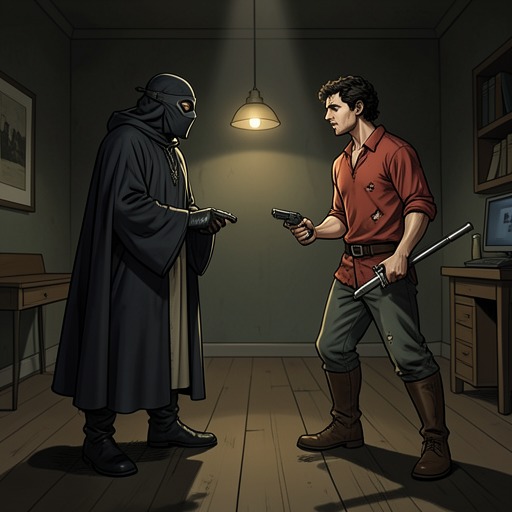
Imperial Inquisitors
The Last JediThe Imperial Inquisitors are the Empire’s Force-sensitive pursuit force, feared by resistance members not only for their capacity to hunt through the Force but for the danger their presence creates for anyone trying to move unseen. Their role shifts as the Empire changes tactics: they are conspicuously absent from some campaigns against the resistance, yet their arrival on Bandomeer is enough to keep Jax Pavan and Laranth Tarak dormant aboard the Far Ranger. Later, the Inquisitor Probus Tesla proposes a surgical means of breaking Thi Xon Yimmon, revealing how the organization’s service to the Empire can extend from pursuit to the attempted exploitation of a prisoner’s mind.
Role in the Empire’s Pursuit
The Inquisitors are presented as Force-sensitive hunters used against Whiplash and its leader, Thi Xon Yimmon. Earlier attempts to annihilate the resistance had involved what the narration describes as raptorlike Force-sniffers. The Empire’s more recent attacks, however, rely on Force-insensitive bounty hunters and battle droids instead. This is a change in method, not evidence that the Inquisitors have ceased to matter: the new approach suggests that the Emperor is bringing mundane weapons to bear after failing to turn the Force-sensitive pursuit against Yimmon and his allies.
That contrast places the Inquisitors within a wider escalation. Imperial orders have shifted from shooting resistance members who obstruct operations to ferreting them out, tracking them down, and destroying them. The Inquisitors represent one particularly threatening instrument of that campaign, while bounty hunters and battle droids show that the Empire can widen its methods when a Force-based hunt has not achieved its purpose. The narrative leaves open whether the change reflects a tactical adjustment or a problem with the Emperor’s earlier approach; it does not establish that the Inquisitors themselves have been disbanded or withdrawn from Imperial service.
Their Effect on Resistance Operations
At Bandomeer, the presence of Imperial forces and one or two Inquisitors determines what the resistance can safely do. Jax Pavan and Laranth Tarak remain aboard the Far Ranger in a state of dormancy rather than risk exposure. Their caution gives the Inquisitors an effect beyond any direct confrontation: simply being in the area restricts the movements of Force-sensitive fugitives and shapes the mission before the hunters need to act on the page.
The practical work of contact and exchange is consequently left to I-Five and Den Dhur, who disguise their purpose while bartering for ionite and making contact with the local Whiplash cell. The contrast is significant. The Inquisitors do not need to identify or capture Jax and Laranth in this episode to impede them; the risk of detection is enough to keep them concealed while their allies operate. The resistance’s movements are therefore governed not only by Imperial patrols but by the possibility that a Force-sensitive hunter may perceive what ordinary surveillance would miss.
Service to Darth Vader
Probus Tesla is shown serving Darth Vader and judging his behavior with the caution expected of a subordinate who understands the cost of misreading the Sith Lord. Tesla senses Vader’s agitation as a chaotic, eddying current, but conceals that perception and does not ask what is troubling him. He understands that even hinting that Vader has lost his customary composure could be dangerous. His private assessment contrasts the Dark Lord’s cold exterior with a passion he imagines as molten heat contained behind an impenetrable surface.
Tesla’s service is also marked by ambition. When he develops a proposed method for making Yimmon more vulnerable to interrogation, he believes the answer lies in surgically disconnecting the two halves of the Cerean’s brain. Vader orders him to arrange for Yimmon to be taken to the infirmary and says he will program the surgical droid himself. Tesla takes this as a professional triumph: he believes he has solved a problem that had frustrated his master and anticipates that the achievement may elevate him in Vader’s estimation. The scene presents the Inquisitor not merely as an enforcer but as an adviser whose technical proposal can direct the treatment of a prisoner.
The proposal is not shown as a completed operation in these passages. Instead, its consequence is an immediate order to prepare for surgery, while Vader’s next question turns suspicion back on Tesla and asks how he came to know what he has said about Yimmon. The abrupt shift checks Tesla’s pride: his apparent success does not place him beyond his master’s scrutiny, and his access to the prisoner’s case becomes a source of danger as well as advancement.
Apprenticeship and Internal Tensions
The Inquisitorius also appears through the relationship between Tesla and his apprentice, Renefra Ren. Tesla senses Renefra’s probing touch in his mental domain and chooses to ignore it, regarding the apprentice’s attempt to snoop as an intrusion into his affairs. The episode suggests that Force-sensitive perception operates within the organization as well as against its enemies: an Inquisitor can be alert to a fellow Inquisitor’s mental reach, even while deciding not to respond openly.
That restraint does not remove the conflict. After receiving word that an intruder has appeared on the station’s monitors and seems to be heading for the detention block, Tesla assumes the intruder is looking for Yimmon. He shuts down the comlink, leaves the medbay, and locks it from the outside while the Cerean remains unconscious. In the corridor he encounters Renefra and rebukes the apprentice for abandoning protocol to follow personal promptings, ordering Renefra to attend their master instead. Tesla then walks on, only to realize that Renefra has not moved. The exchange gives the Inquisitors a limited but concrete internal structure—master, apprentice, and an expectation of obedience—while exposing tension between institutional duty and personal initiative.
Narrative Significance
The organization’s presence connects two forms of pressure on the resistance: the overt hunt for Force-sensitive fugitives and the threat of what Imperial custody may do to a captured leader. On Bandomeer, the Inquisitors constrain the resistance without a direct encounter. In Vader’s station, an Inquisitor’s recommendation helps set a possible brain operation in motion. These episodes widen the meaning of the hunt: being found is not the only danger; capture can lead to an effort to dismantle the mental defenses that made a prisoner difficult to interrogate.
At the same time, the account does not make the Inquisitors an all-purpose explanation for every Imperial setback or success. The Empire shifts to bounty hunters and battle droids when its Force-based tactics have not sufficed, while Tesla’s plans remain subject to Vader’s authority and suspicion. The Inquisitors are formidable instruments, but they operate within a larger apparatus of Imperial force and under a master whose control extends even to the procedures they propose.